
Advice for new writers
Doesn't everyone have a book in them?


Recently, I was sitting at my desk editing my second book, The Mysterious Death of Miranda Hall, when my phone rang. It was a number I didn’t recognise, so I almost didn’t answer it. Answering rather tersely, a friend of mine said, ‘Hey, do you have a minute?’
Caught slightly off-guard, I quickly regained my composure and my friend went on to say that a good friend of his had been offered a contract to publish his book. ‘Wonderful news,’ I said. My friend wondered if I would be kind enough to take a look at the contract to see if it was fit for purpose.
My immediate reaction was to say that I’m not qualified to look over contracts and the best people to offer advice would be the Society of Authors. They offer this brilliant service for free to fully paid up members. Before jumping in though, I listened to what he had to say and then the penny dropped. The so-called publishing contract was, in fact, an offer from a vanity publisher. The author thought he had hit the publishing jackpot when the company only asked him for £3,500 (initially) for a print-run of books, but then went on to outline various other percentages. All of which I have no doubt, were significantly in their favour. He gave me the name of the company, I Googled them and my suspicions were confirmed.
Apparently, the company had called the author up and were incredibly enthusiastic about his brilliant book (which I have no doubt that it is a brilliant book.) However, if a book is that good, then you won’t need to pay a penny to have it published.
As soon as the call to my friend had ended, I received the call from his friend. He was keen! I spent about half an hour going through the various options of how he could get his book published. First, though, I asked him to tell me a little bit about his book.
After five minutes of in-depth conversation, it turns out that he has written a series of four books in the fantasy genre. I did not doubt the enthusiasm he had for his work, which shone through immediately. What I had to try and find out was:
did he want to publish his work?
if so, which publishing route did he want to take?
did he want to be traditionally published?
had he thought about pitching to an agent?
did he want to go down the Indie/Small Press route?
had he thought about going down the self-publishing route?
When it became clear that yes, he did want to get his books out there, (not for the money but so that people could enjoy them), I then went through the various options.
It is a lot to take in. I tried to explain everything in layman’s terms as best I could. My advice was to treat pitching his book like a job interview. When you apply for a job, it is best practice to tailor your CV to the specific post that you are applying for. In other words, if your book is a fantasy novel aimed at middle grade readers, don’t pitch it to a publisher who only publishes horror or non-fiction. That may seem like an obvious thing to do, but it’s surprising how many writers don’t do their research properly and end up receiving rejection after rejection. Which is not surprising if you are pitching your book to the wrong people.
The Writers’ and Artists’ Yearbook is always a great place to start. You can look up publishers, agents and so much more, which will give you a good grounding of where might be a good place to pitch your book. Or send the manuscript. Again, most publishers have different criteria. For example, some want to see the first 10,000 words, a synopsis and a covering letter. Others want the first 3 chapters, a synopsis and a one line elevator pitch. It is important to send what the publisher is asking for and to address the email to them. It’s a big no-no to send a blanket email pitching a handful of publishers or agents. Tailor your pitch to the specific agent or publisher that you would like to represent you or publish your book and prove to them that you have done your research. After all, you are entering into a business relationship with this person, so you need to be able to relate to them and prove your worth as a possible client.
The difference between pitching to a publisher is that you, as the author, will deal with them directly, rather than an agent doing it for you. This means that if you are offered a contract, it is up to you to read through it and check that you are not giving away the rights to your manuscript. As I mentioned earlier, the Society of Authors is a great place to start if you are serious about your writing and want to become a published author. They will read over the contract for you and point out any weaknesses or areas which may need re-visiting to protect you and your manuscript. Publishers also work on a commission and you will earn royalties on sales of your book. They will never charge fees upfront. If they do, they are vanity publishers and should be avoided.
If you decide to pitch to a literary agent, and you are fortunate enough to be represented by one, they will do all the negotiating with the publisher for you. In other words, they will fight your corner and get the best deal they can for you and your book. This comes at a cost as most agents charge 15% for domestic sales and 20% on foreign or international sales. They make their money from the book sales. The more they sell, the more they earn. Which is fair enough. Again, there are no upfront fees. If an agent asks you for a fee, they are not for you.
Sometimes, it can feel like a catch 22. For example, the “Big 5” publishers in the UK which dominate commercial book sales, (Penguin Random House UK, Hachette UK, Harper Collins UK, Pan Macmillan and Simon & Schuster UK) often do not accept unsolicited manuscripts, and will only consider submissions from literary agents. I think it is every author’s dream to be published by one of the “Big 5” because they have such a huge reach and can potentially launch an author’s career into the stratosphere. It has always been my dream to be published by one of the “Big 5”. Therefore, I need an agent.
Going back to my friend’s friend, he was completely unaware of the fact that he was (kind of) being scammed by a vanity publisher. He was surprised when I told him that if his books were worth publishing (which I am sure they are) then he should not pay any upfront fees. That goes for agents too. They make their money from the book sales. The more they sell, the more they earn. Which is fair enough. 15% of nothing is nothing. 15% of tens of thousands of book sales could be very lucrative indeed. I am not sure which route he will take, but I suggested that he started by pitching to agents who specialise in middle grade fantasy fiction.
What this author did understand, however, was that once your book is accepted for publication, a lot of the marketing will fall to you, which he was happy with. Book signings, talks, festivals and book fairs are all part and parcel of being an author. Readers want to know about who wrote the book. It’s human nature and so we must be prepared to give as little or as much of ourselves to our readership as we feel comfortable with. Having an online presence can help. A website, social media profiles and a platform (Substack is brilliant!) where you can showcase your work. It also helps build your following of loyal readers who will hopefully buy your next book and the one after that too.
Some people just love to write and have no inclination to get their work published. That is absolutely fine and sometimes, I wonder whether chasing that elusive publishing deal is worth all the effort. I was ‘lucky’ enough to be published by a traditional publisher but just four months later, my contract was cancelled. Just like that. My heart was broken and I wondered how I would recover. But I did. I dusted myself down and self-published The Mysterious Disappearance of Marsha Boden. I am still looking for an agent to represent me and will not give up on my dream of being published by one of the “Big 5”.
Even if you do not intend to track down a major publishing deal, writing that book can offer immense value. Here is what Google AI says about getting that book out of you:
Therapeutic Catharsis: Writing down memoirs or personal struggles can be incredibly healing.
Preserving History: An autobiography or family history serves as a priceless heirloom for your descendants.
Creative Joy: The act of world-building and character development is fulfilling purely for the pleasure of creation.
I have not had experience of Indie/Small Presses, but there are small, independent publishing companies who operate on a smaller scale than corporate publishers. They will usually handle the editing, cover design, printing and distribution which leaves the author more time to get on with their next book.
Personally, I find self-publishing very labour intensive and incredibly frustrating. It involves a whole gambit of skills that I do not possess and quite frankly, do not wish to learn about, but have been forced to. Amazon rankings and how to trigger that elusive A9 algorithm, Search Engine Optimization, registering your ISBN, getting involved with distributors. And the list goes on and on. I just want to write books, but realise that I must help to promote my work in whatever way that I can. Again, if you have one of the big publishers behind you, and/or and agent, a lot of this is all done for you by their amazing teams who work tirelessly behind the scenes to get your book out there.
Whichever route you decide to take, or have taken, it must be right for you. It is hard work being a published author and if you do get a 3 book deal or a 5 book deal, then the pressure is on to produce those books within a time frame stipulated by the contract. Could you handle that? If the financial rewards are there, I guess most people could. But it’s not for everybody and some people actively avoid that kind of pressure. I work well under pressure so would not see that as an issue.
If you have any questions about publishing your work, or you want to share your experience of self-publishing or otherwise, please leave a comment so that we can all learn from each other. I am sure I have only touched the tip of the iceberg in relation to all the processes of getting your book ‘out there.’
Have a great week and happy writing!
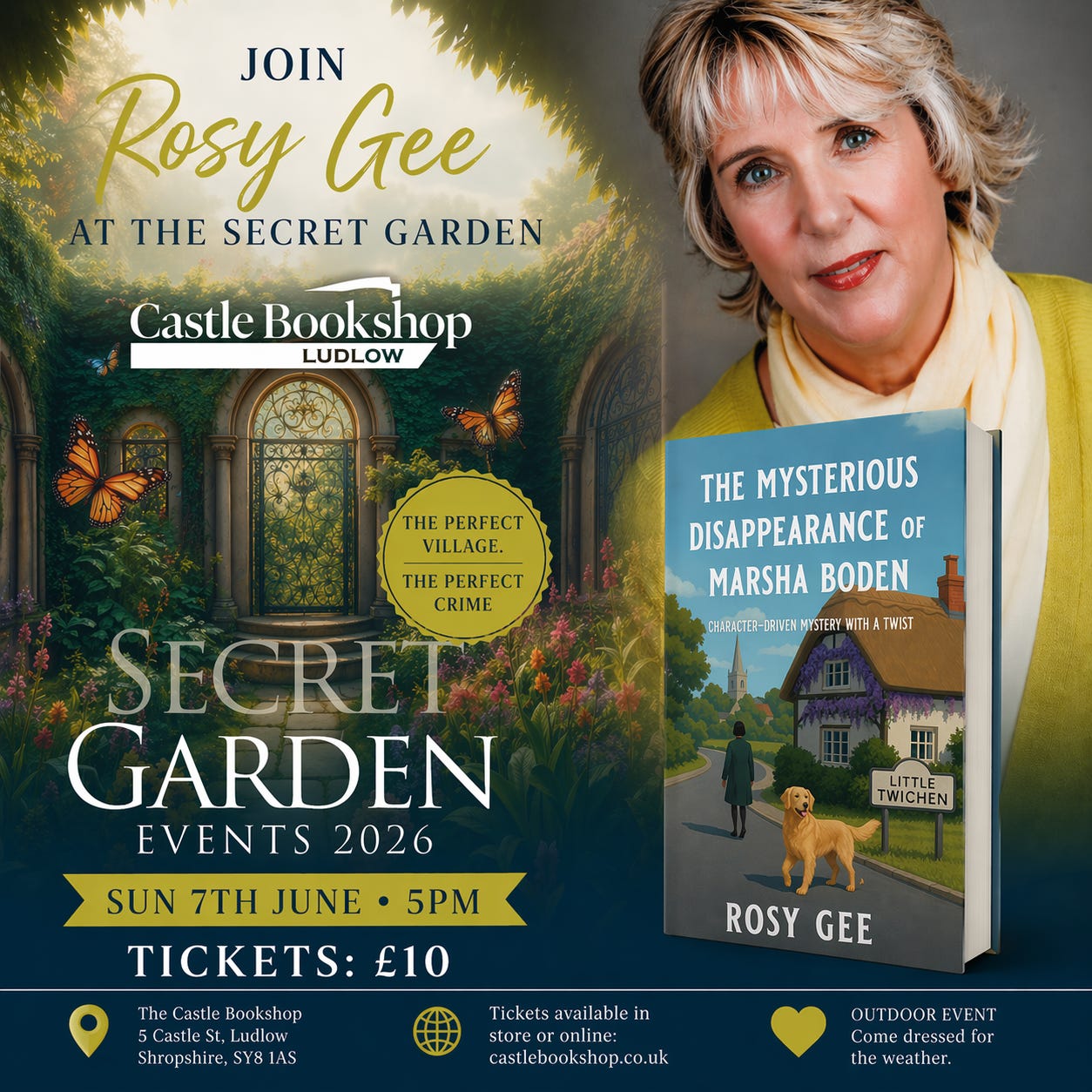
P.S. Don’t forget that I will be in The Secret Garden in Ludlow on Sunday, 7th June at 5:00 pm if you want to come along and hear me talking about how I got the inspiration to write my debut novel, and my publishing journey to date. The ticket price includes a glass of wine. It would be great to see you.
It really is personal choice. After a near-miss that was similar to yours I made the call early on to self publish and built my "team". I've had the same editor (who works also in the trad market so has to be "booked" for my work, thereby giving me deadlines) for all 20 books and the same cover designed for most. I'm crap at marketing, like really crap, but the pay-off for me is being able to write the stories I want to write without asking for permission. Would I love to be published by one of the big 5 and see my books in airports? Yep. Absolutely. That's still the dream.
I went for having a service provider do my self publishing, which meant they designed the cover, did the formatting, and the uploading. None of which I felt capable of doing on my own. Naively, I thought I could just give them the manuscript and they would hand back a book. Well, I did get a book that I am pleased with, but it was by no means a quick and/or easy process. I found it stressful, frustrating, tiring, and endless, but in the end, I'm pleased with the book they produced. I don't think I would have been able to achieve it without their expertise. It was expensive, but I knew it was either give it to them to do professionally or give up on the book entirely. So, really, no choice at all.